Distress Alert/Distress Call.
Comunicación -Medida – Respuesta.
Comunicación…perfecta.
Medidas…planificadas.
Respuesta…inmediata.
A la flota pesquera Española, por lo demostrado, le cuesta entenderlo.
Sólo otro sitio de WordPress
Distress Alert/Distress Call.
Comunicación -Medida – Respuesta.
Comunicación…perfecta.
Medidas…planificadas.
Respuesta…inmediata.
A la flota pesquera Española, por lo demostrado, le cuesta entenderlo.
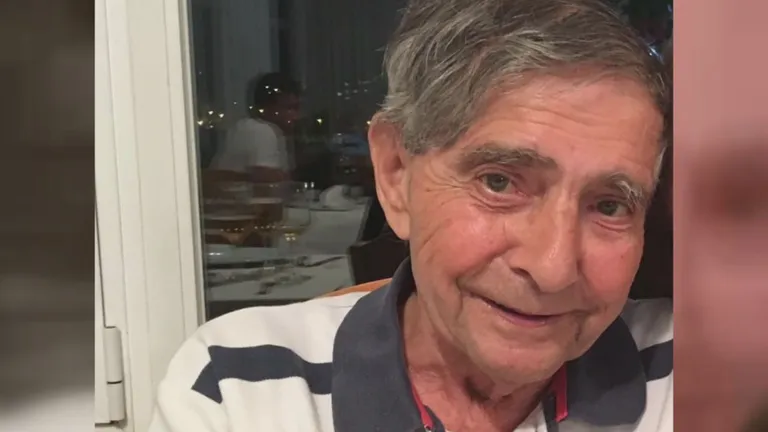
Laureano Aragón, sindicalista de UGT, sentía gran aprecio por la prensa.
Laureano Aragón se incorporó a la Unión Comarcal de UGT A Coruña en 1994 como secretario de comunicación, área en la que permaneció hasta el final, con sus 80 años cumplidos. Procedía de la antigua Federación de Transportes, Comunicación y Mar, en donde también llevaba a cabo estas tareas.
Su labor fue imprescindible en el desarrollo de nuestras actividades, ya fuesen movilizaciones, jornadas, congresos, actos de homenaje… Su relación con los trabajadores de los medios nos permitía trasladar a la opinión pública todas nuestras iniciativas. Él me fue presentando a todos los profesionales de la comunicación, que luego fueron dando cobertura a nuestro quehacer diario a lo largo de tantos años.
Laureano tenía mucho aprecio a todos los periodistas que conocía, de los que siempre me hablaba y de los que tenía una lista de teléfonos. Siempre que hacíamos un acto, recurría a su lista. Y llamaba uno por uno a todos sus contactos. Si no le daba tiempo en el sindicato, lo hacía desde su casa. Para él, que las ruedas de prensa o presentaciones saliesen bien era un motivo de orgullo.
Su trabajo en Radio Exterior de España con Españoles en la Mar le forjó ese carácter periodístico que lo acompañó siempre con su amigo de anécdotas, Antón Luaces, del que siempre nos contaba alguna nueva.
De profesión marino mercante, en la especialidad de radio, viajó por todo el mundo y de sus bajadas a tierra contaba infinitas historias que nos han hecho reír muchas veces. Era de carácter alegre, amigo de la tertulia, rápido de reflejos en las respuestas y contaba con una memoria prodigiosa que le hacía recordar los nombres de personas que hacía 20 o 30 años que no veía.
Le gustaba leer la prensa todos los días y mantuvo esa tradición de mirar las predicciones y comentar «está la presión alta», «no va a llover», «hay anticiclón en las Azores»… porque seguía mirando el tiempo y el mar, que formaron parte de su vida.
Para los compañer@s de UGT se ha ido un amigo. Su recuerdo y sus anécdotas estarán siempre con nosotros. Para mí, Laureano fue, como él mismo decía, «mi guardaespaldas», el amigo que siempre estaba ahí.
Que los vientos te sean favorables.
A la familia, a su esposa Chiruca y a sus hijos, todo el cariño de todos los ugetistas.
*José Carrillo es un histórico dirigente de UGT en A Coruña.
Fuente:lavozdegalicia.es
Un abandono de buque es extremadamente complicado.
Indian Coast Guard Rescues 21 From Liberian flagged container vessel MSC ELSA 3 Sank off Kochi.
Indian Coast Guard ON HIGH ALERT FOR POLLUTION RESPONSE EFFORTS SUBSEQUENT TO SINKING OF MSC ELSA 3 (IMO NO. 9123221) OFF KOCHI
National Defence Bureau,
New Delhi, 25 May 2025
In the early hours today at around 0750 hrs, MSC ELSA 3 (IMO NO. 9123221) sank off Kochi due to flooding, all the 24 crew were rescued safely 21 by Indian coast guard and 03 by INS Sujata. Indian Coast Guard is monitoring the situation closely for any oil or chemical spill and is fully geared up to respond to any emerging situation. Details of the incident are as below.
At around 1325 hrs on 24 May 25, information was received by Indian Coast Guard regarding distress conditions onboard Liberian flagged container vessel MSC ELSA 3 approximately 38 nautical miles from Kochi. The vessel had developed a 26 degree list to Starboard side and was at a risk of capsizing. The shipping company was unable to establish communication with the vessel and had requested ICG assistance to ensure safety of the 24 crew onboard the vessel. The reason for the list is yet to be ascertained.
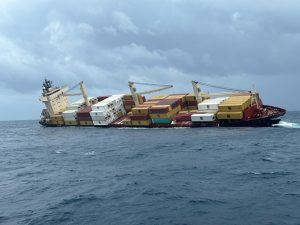
MSC ELSA 3 (IMO NO. 9123221) sank off Kochi.
On receipt of information, Maritime Rescue Sub-Centre under ICG District Headquarters at Kochi tasked ICG Dornier aircraft to undertake aerial surveillance and establish communication with the vessel. Responding promptly, the aircraft located the vessel and identified two liferafts in water with 05 and 04 survivors respectively. A few containers were also identified floating near to the distress location.
ICG ships on patrol were also diverted towards the distressed vessel. In view of the gravity of the developing situation, MRSC diverted two merchant vessels in the vicinity, MV Han Yi and MSC Silver 2, to the position of distressed vessel in accordance with global Search And Rescue (SAR) procedures. To further aid a prompt SAR, the ICG Dornier aircraft air dropped liferafts to augment rescue of survivors. 12 more crew abandoned the vessel into the ICG life raft and were rescued by ICG ship Arnvesh. MV Han Yi rescued 09 survivors from the two liferafts. INS Sujata also joined the operation on 24 May 25.
The 184 m long container vessel had sailed from the port of Vizhinjam near Thiruvananthapuram on 23 May 25 for the port of Kochi, with a scheduled entry on 24 May 25. Enroute Kochi, the vessel developed a significant list to Starboard side resulting in some of the crew abandoning the ship into liferafts. As of 2200 hrs on 24 May 25, 03 crew i.e Captain, Chief Engineer and the 2nd Engineer, remained onboard the distressed vessel to facilitated salvage operations being scheduled by the ship managers. ICG ship Saksham with pollution response equipment has been positioned at the scene to response to an oil spill scenario, if any.
In the early hrs of 25 May 25, MSC ELSA 3 listed rapidly and capsized in position 09 Deg 18.76 N 076 Deg 08.12 E and sank. The three remaining crew abandoned the sinking vessel and were rescued by INS Sujata which joined operations last evening.
The 24 crew include 01 Russian (Master), 02 Ukrainian, 01 Georgian and 20 Philippines nationals. Of the 640 containers onboard, 13 contained hazardous cargo while 12 containers of cargo with calcium carbide were present. The ship had in its tanks, 84.44 MT of diesel and 367.1 MT of furnace oil.
The sensitive coast of Kerala is home to both a vivid biodiversity as well as a major tourist attraction. ICG has geared up pollution response preparedness and coordination with State administration of all possible scenarios. ICG aircrafts with advanced oil spill mapping technology is undertaking assessment of the situation. Presently, no oil spill has been reported.
The Indian Coast Guard is fully geared to respond to the emerging scenario and is closely monitoring the environmental impact in the aftermath of sinking of MSC Elsa 3.
The vessel went down with 640 containers, including 13 with hazardous cargo and 12 containing calcium carbide.
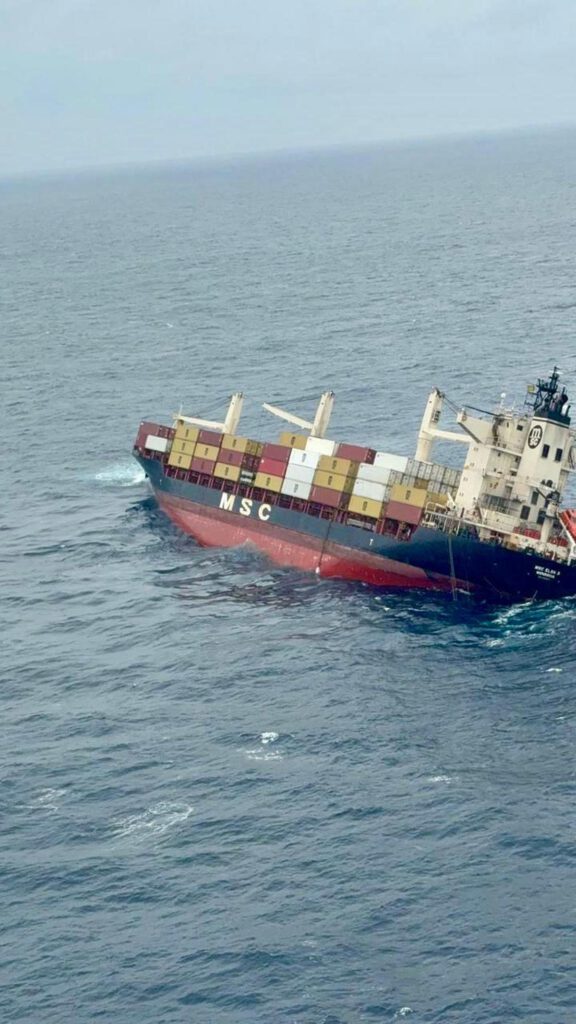
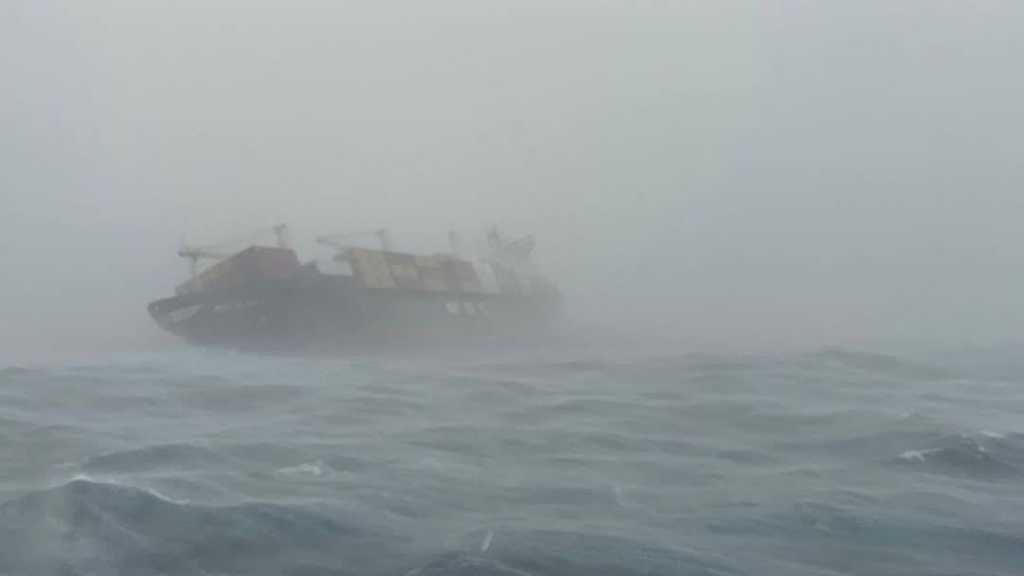
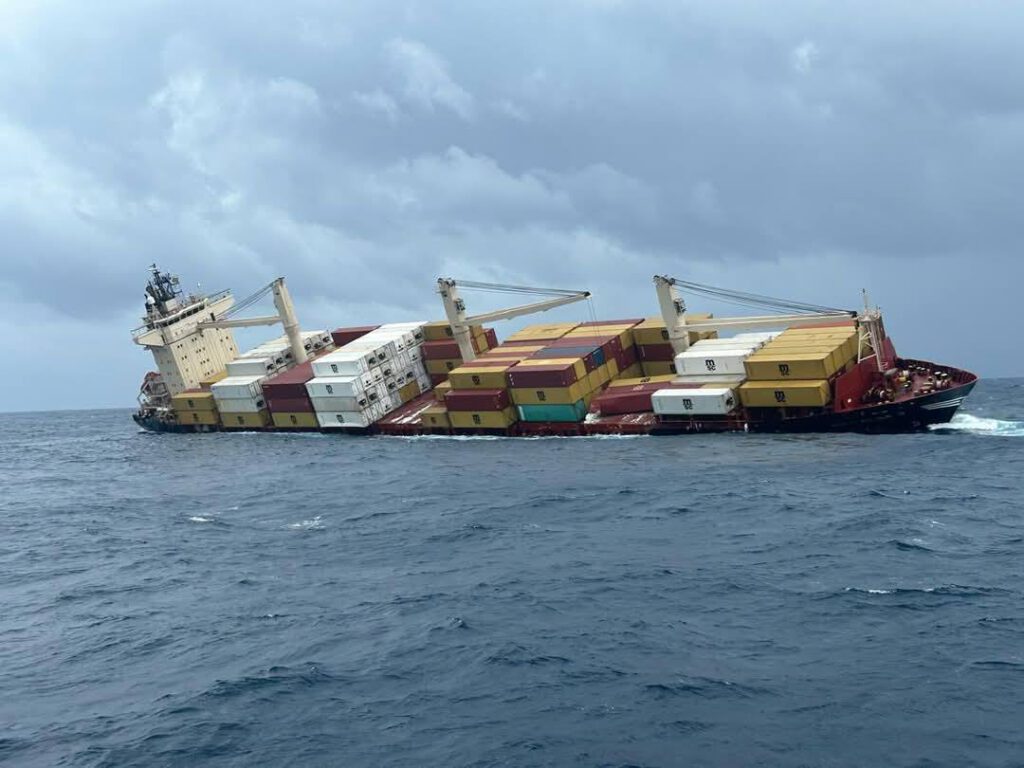
The 184-metre-long Liberia-flagged container vessel, MSC ELSA 3, that tilted approximately 38 nautical miles southwest of Kochi seen on May 24, 2025. Photo: Special Arrangement | Photo Credit: The Hindu.
The Ministry of Defence has on Sunday (May 25, 2025) noon officially confirmed the sinking of Liberian container ship ‘MSC ELSA 3’ off the Kochi coast earlier in the day, ‘due to flooding’.
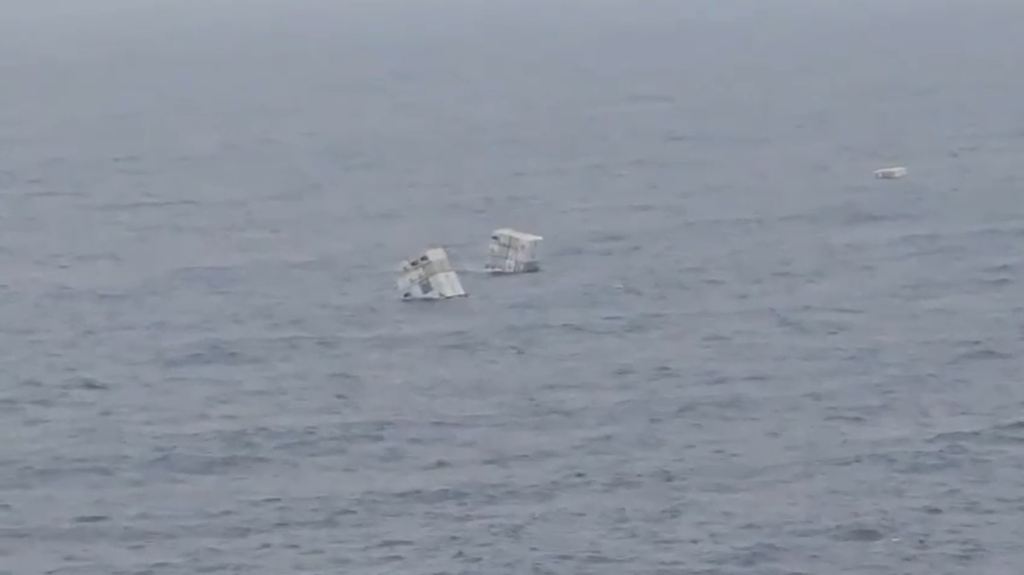
Screengrab from video showing debri in of the sunken vessel. Photo: Special Arrangement.
The vessel went down with 640 containers, including 13 with hazardous cargo and 12 containing calcium carbide. It was also loaded with 84.44 MT of diesel and 367.1 MT of furnace oil.
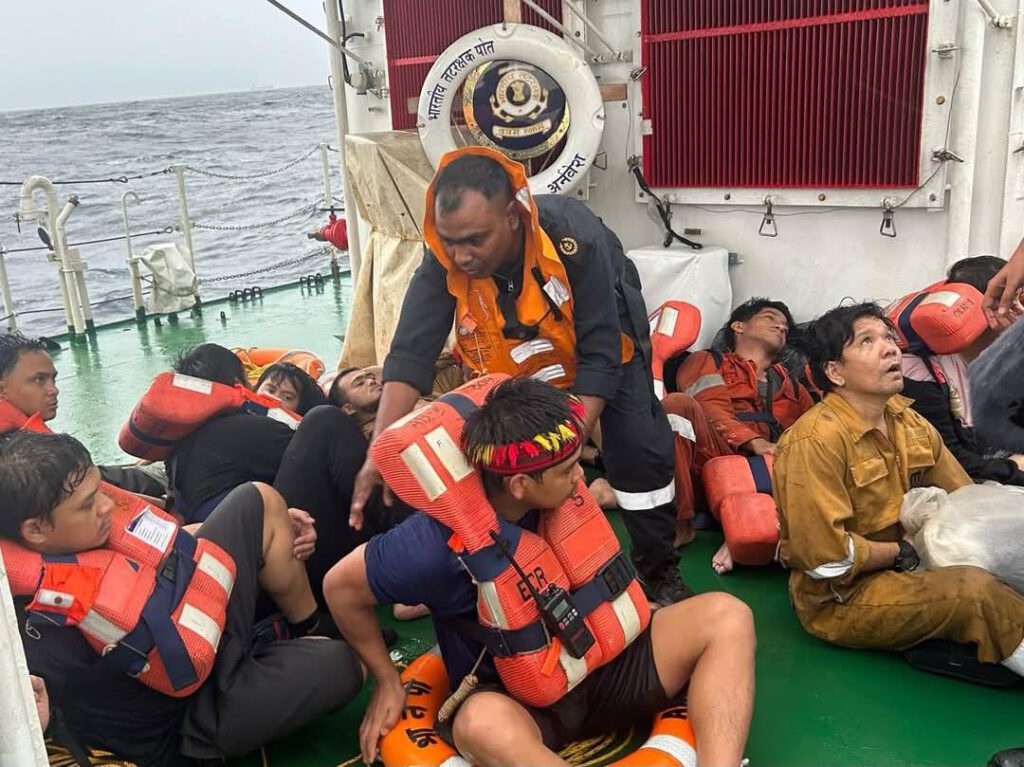
All 24 foreign crew members on board were rescued, 21 by Indian Coast Guard (ICG) and three — including the ship’s captain who is a Russian national, and its chief engineer, by the Indian Navy’s INS Sujata. The ship bearing IMO number 9123221 sank at around 7.50 am, says an official communication.
Given the sensitive marine ecosystem along the Kerala coast, ICG has activated full pollution response preparedness. ICG aircraft equipped with advanced oil-spill detection systems are conducting aerial surveillance, and ICG ship Saksham, carrying pollution-response equipment, remains deployed at the site. So far, no oil spill has been reported.
The emergency situation began on Saturday (May 24, 2025), when the ship developed a 26-degree tilt whilst en-route from Vizhinjam to Kochi, while located approximately 38 nautical miles south-west of Kochi and lost stability, prompting a distress call.
The ICG’s Maritime Rescue Sub-Centre (MRSC) in Kochi immediately launched a coordinated response. The Coast Guard’s Dornier aircraft that was deployed for aerial surveillance, spotted two liferafts with survivors. Subsequently, ICG patrol ships and merchant vessels MV Han Yi and MSC Silver 2 were diverted to assist (the stranded crew), in line with global search and rescue protocols.
By late evening on Saturday, 21 of the 24 crew, including nationals from Russia, Ukraine, Georgia, and the Philippines, were rescued, while three senior crew members remained onboard to assist with salvage arrangements. However, the vessel’s condition deteriorated overnight and it capsized on Sunday morning. The three crew members were forced to abandon the ship and were rescued by INS Sujata. The reason for the tilting is yet to be ascertained, the communication says.
The ship’s tilting and the falling off of a few containers having potentially hazardous cargo had created a scare across the Kerala coast. This led to issuance of an extraordinary alert by the Kerala State Disaster Management Authority (KSDMA) on Saturday evening. People have been alerted neither to approach nor touch the cargo in the event of it washing up along the Kerala shore.
Fuente:theindu.com
https://www.facebook.com/share/p/18WPrRmihZ
ÚLTIMA HORA: Toda la tripulación filipina está a salvo después de que MSC ELSA 3 se hunda de Kochi I rbbolivar
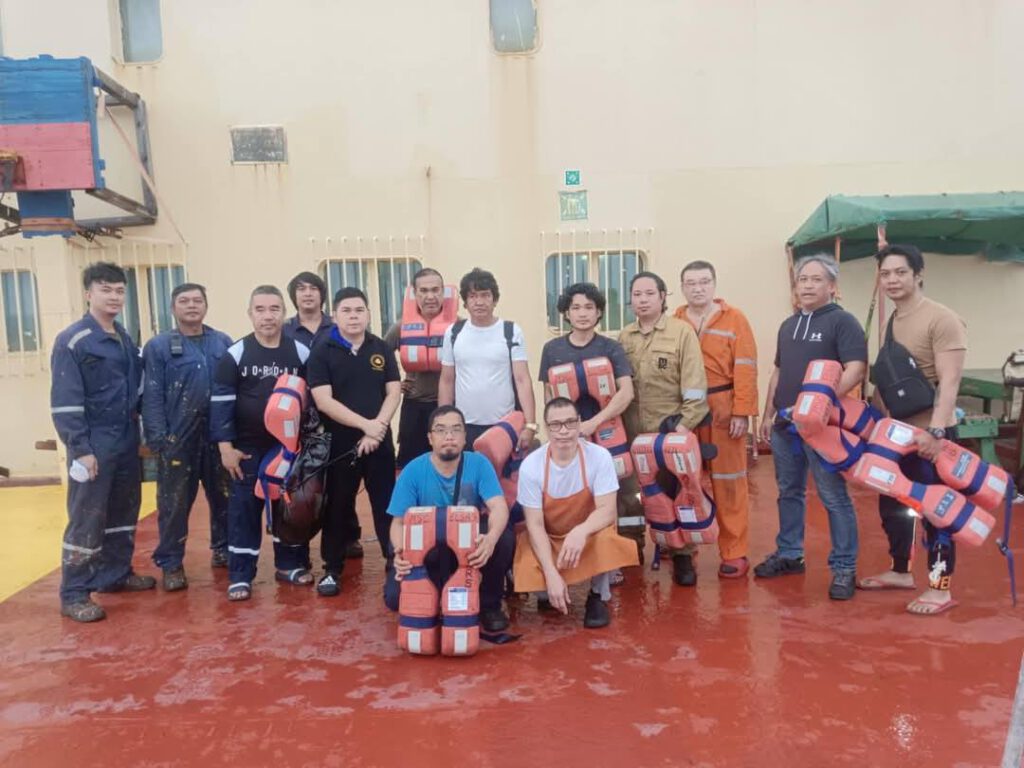
Todos los 24 miembros de la tripulación, incluyendo ciudadanos filipinos, fueron rescatados a salvo después de que el buque portacontenedores con bandera liberiana MSC ELSA 3 se hundiera frente a la costa de Kochi, India, esta mañana temprano. La Guardia Costera India (ICG) rescató a 21 miembros de la tripulación, mientras que los 3 restantes fueron salvados por el buque de la Armada India Sujata.
El buque transportaba 640 contenedores, 13 de los cuales contenían carga peligrosa y 12 otros con carburo de calcio. El combustible a bordo incluía 84,44 toneladas métricas de diesel y 367,1 toneladas métrica de aceite de horno.
El ICG ha lanzado una operación de respuesta a la contaminación a gran escala y está coordinando estrechamente con la administración estatal de Kerala para manejar la situación. Las aeronaves equipadas con sistemas avanzados de cartografía de vertidos de petróleo están realizando vigilancia aérea de la zona. Hasta este informe, no se ha detectado ningún derrame de petróleo.
El ICG continúa vigilando de cerca la situación, comprometido a salvaguardar la seguridad marina y proteger el frágil ecosistema costero de Kerala.
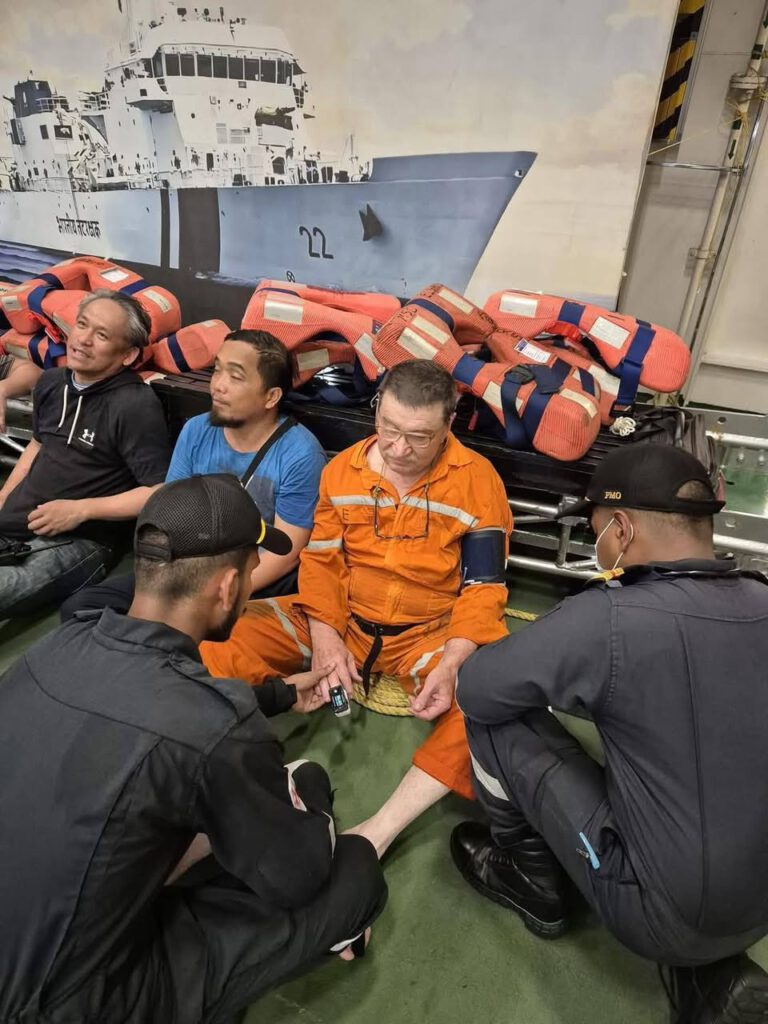
Foto cortesía de: GUARDIA COSTA INDIO
24 Maio 2025

O programa decano de Radio Exterior de España Españoles en la Mar, que tiven a honra de dirixir e presentar durante moitos anos, cumpre 40 anos e, neste aniversario, as directoras actuais do mesmo contaron coa presencia nel, nun improvisado estudio instalado a bordo do buque-escola da Armada española Juan Sebastián de Elcano, da princesa Leonor, herdeira ao trono de España. O buque, con dona Leonor a bordo en calidade de alumna, recalou na República Dominicana onde permanecerá ata a súa partida cara a Nova Iorque onde rematará este novo periplo de instrución antes de render viaxe en Marín, cadrando coa celebración da festa da patroa do Mar, a Virxe do Carme.
Esta circunstancia que ten á princesa Leonor como protagonista a bordo do Elcano, fixo que me lembrara dos moitos programas de “Españoles en la Mar” emitidos dende os estudos de RNE na Coruña, Vigo, Santiago, Pontevedra, Barcelona, Cartagena, Valencia, etc., coa colaboración inapreciable de mariños coma Benxamín Sande, Laureano Aragón, Antón Salgado, Xosé Manuel Muñiz, entre outros, e as múltiples conexións que efectuamos con profesionais do mar galegos -nomeadamente do Barbanza e O Morrazo- en distintos mares e países.
Nunha ocasión entrevistamos ao daquela comandante do xa citado Juan Sebastián de Elcano, Juan Francisco Martínez Núñez, posteriormente Almirante da Armada, fillo dun exdirector da Escola de Transmisións da Armada (ETEA), Juan Martínez Martínez, ambos os dous de Ribeira. Curiosamente, foi ao longo da conversa co comandante Martínez Núñez, como me enterei de que estaba a entrevistar a un curmán político. E foi grazas a el mesmo, que mo lembrou on moita risa polo medio.
Nos primeiros 40 anos de vida de Españoles en la Mar fago memoria deste caso tendo moi en conta o que na miña vida significou -e aínda significa- este programa mesmo pasados xa 18 anos da miña xubilación. Longa vida para todos.
Fuente:obarbanza.gal
Celebrado del 13 al 22 de mayo 2025.
Clausura.
Sin novedades.
Nada se habló del colapso del GMDSS.
Más aportaciones de 2013.
Hasta cuando ?
Justificación
Naufragio pesquero » Costero Segundo » en aguas de Cartagena el pasado dia 6 de febrero de 2013.
La formación del Sistema Mundial de Socorro un recurrente fraude al erario público y a la seguridad de la vida humana en la mar.
Los mandos de los buques pesqueros » Costero Segundo y Marufina » incumplieron el Reglamento de Radio Comunicaciones.
La Comisión de Investigación de Siniestros Marítimos debería identificar de forma inequívoca el Centro de Formación que expidió el Certificado de Operador del GMDSS a estos dos patrones de pesca.
Nuestro Grupo, exige un investigación de oficio en los Centros de Formación públicos o privados para que quede constancia de forma fehaciente sobre el número de alumnos aptos y no aptos, normas de calidad y control sobre instructores o evaluadores.
De igual forma, insta al Ministerio de Fomento a que se estudie la fórmula para un exhaustivo control de los exámenes.
INFORME
El naufragio del pesquero español » Costero Segundo » ha significado la constatación definitiva del fraude en la formación del Sistema Mundial de Socorro.
Los pesqueros » Costero Segundo y Marufina » tenían en sus Puentes de Gobierno todos los elementos indispensables para la activación y gestión de los Subsistemas y Métodos del Sistema Mundial de Socorro.
Nada se ha cumplido del Reglamento de Radiocomunicaciones de 2006.
Entrar en el análisis secuencial de los tiempos de respuesta de Sasemar, vista su nota de prensa, es perder el tiempo.
Se vuelve a demostrar, una vez más, la sistemática conculcación de España como Estado Miembro de OMI, en lo que respecta al ordenamiento jurídico nacional e internacional.
Urge una investigación a fondo de los Centros de Formación del Sistema Mundial de Socorro.
Distintos y numerosos Centros de Formación reciben ingentes cantidades de dinero público para garantizar la seguridad de la vida humana en la mar.
De igual forma, titulados de la marina civil, pagan de sus bolsillos la preceptiva formación para obtener sus Certificaciones de Operador GMDSS.
En cualquiera de los casos, los Centros, siempre consideran aptos a los asistentes a sus cursos.
Las razones, son obvias.
Si los asistentes se consideran no aptos, se pierden ingresos económicos.
La única fórmula viable para mejorar la evaluación sería la misma que la establecida para la Náutica de Recreo, es decir, que sea personal seleccionado de la Dirección General de la Marina Mercante, quien examine y evalúe de forma independiente.
El Comité de Seguridad Marítima de OMI deja a España en muy mal lugar.
Fomento y Verificación de la familiarización permanente de los operadores del Sistema Mundial de Socorro que prestan servicio a bordo.
En su [81º periodo de sesiones (10 a 19 de mayo de 2006)], el Comité de Seguridad Marítima, atendiendo a las propuestas formuladas por el Subcomité de Normas de Formación y Guardia en su 37º periodo de sesiones, aprobó las recomendaciones sobre el fomento y la verificación de la familiarización permanente de los operadores del Sistema Mundial de Socorro que prestan servicio a bordo.
Se invitaba entonces a los Gobiernos Miembros a poner las recomendaciones adjuntas en conocimiento de todas las partes interesadas, a fin de que las tuvieran en cuenta y tomaran las medidas que estimasen oportunas.
Quedó constancia sobre la preocupación de la Organización Marítima Internacional, por el hecho de que muchos operadores del Sistema Mundial de Socorro a bordo de los buques carecían de familiarización respecto del funcionamiento operacional en cuanto a las comunicaciones de socorro, urgencia y seguridad, así como sobre elementos técnicos básicos, esenciales para la seguridad de la vida humana en el mar.
Teniendo presente aquella inquietud, se formularon las siguientes recomendaciones de cara al futuro:
El sistema de gestión de la seguridad del buque debería garantizar que todo el personal al cual se pueda pedir que haga funcionar el equipo del Sistema Mundial de Socorro se familiarice y reciba formación específica sobre el buque al incorporarse al mismo, y posteriormente a intervalos adecuados.
La familiarización, ejercicios y formación a bordo respecto del equipo del Sistema Mundial de Socorro deben permitir que los operadores del SMSSM demuestren su familiarización en todo momento.
Esta familiarización debe verificarse durante las inspecciones en ejercicio de la supervisión por el Estado de abanderamiento o por el Estado rector del puerto.
Si tales verificaciones arrojan resultados negativos, la Compañía o Casa Armadora, debe adoptar las medidas oportunas con arreglo a las prescripciones de la Administración del Estado de abanderamiento.
Sirva también como ejemplo, que el Comité de Seguridad Marítima de la Organización Marítima Internacional, en su [83º periodo de sesiones (3 a 12 de octubre de 2007)], consciente de la importancia de reducir al mínimo los retrasos en la respuesta de búsqueda y salvamento a los alertas de socorro alentó a los Estados Miembros a que satisfagan las obligaciones que les corresponden en virtud del Convenio Internacional de Búsqueda y Salvamento y otros instrumentos internacionales.
Para ello, aprobó las orientaciones preparadas por el Subcomité de Radiocomunicaciones y de Búsqueda y Salvamento (COMSAR), en su 11º periodo de sesiones.
El propósito de las referidas orientaciones era/es reducir al mínimo los retrasos en la respuesta de búsqueda y salvamento a los alertas de socorro, y en particular, a los alertas de socorro recibidos por el sistema COSPAS-SARSAT.
Se recordó a los Estados las obligaciones que les corresponden en virtud del Convenio SAR y otros instrumentos internacionales pertinentes.
En virtud de estos instrumentos, se seleccionaron algunos extractos de dichos documentos a modo de indicación como medio para comprender mejor las obligaciones de los Estados y cómo estas obligaciones pueden cumplirse de manera individual o en cooperación con otros Estados.
En estos extractos se contemplan las regiones de búsqueda y salvamento que se establecen para asegurar :
a.- el suministro de una infraestructura de comunicaciones adecuada.
b.- un encaminamiento de las alertas de socorro eficiente.
c.- una coordinación operacional apropiada para apoyar eficazmente los servicios de búsqueda y salvamento.
España, cuenta con todos los sistemas para cumplir con estas obligaciones, pero por distintas circunstancias, no se cumplen.
En La Coruña, a 11 de febrero de 2013.
Fdo :
Antón Salgado/Luis Milian
Coordinadores
Más de lo mismo.
Proyectos de nuevos sistemas, aparentemente obsoletos, más enmiendas y…más negocio.
La pregunta.
Podra asumir la Gente de Mar tanta tecnología y formación ?
IMO NCSR 12: Key outcomes
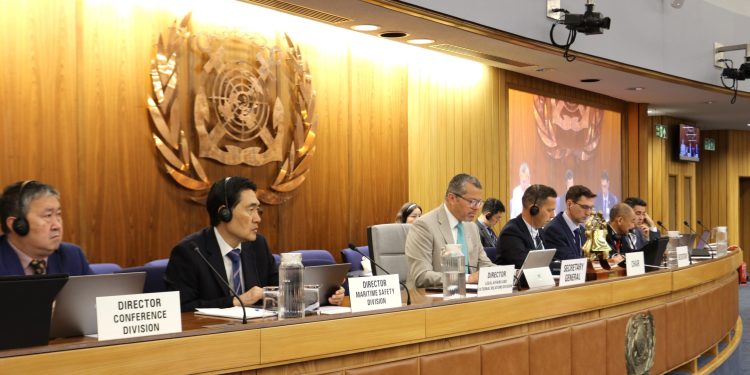
The IMO Navigation, Communications and Search and Rescue Sub-Committee (NCSR 12) took place on 13 – 22 May 2025 at the IMO in London.
Loyd’s Register has issued a report outlining the key outcomes of the Committee, where all matters related to navigation and communication, as well as search and rescue and the Global Maritime Distress and Safety System were discussed.
The safety of shipping and the cleanliness of oceans are enhanced by routing measures and ship reporting systems. Ship reporting systems further improve safety by providing real-time information on ship movements. SOLAS Chapter V designates the IMO as the sole international authority for establishing these systems, ensuring safe and efficient maritime navigation.
NCSR agreed on the following:
The finalised drafts are expected to be adopted at MSC 111 in May 2026, with implementation expected six months later.The finalised drafts are expected to be adopted at MSC 111 in May 2026, with implementation expected six months later.
Information was submitted regarding the change of Chart Datum and value of minimum depth of 17.60 m in the deep-water route within the South Åland Sea traffic separation scheme. A proposal to issue an addendum 3 to SN.1/Circ.272 was approved by NCSR.
The Very High Frequency (VHF) Data Exchange System (VDES) integrates the functions of terrestrial and satellite VHF data exchange, Application Specific Message (ASM) and Automatic Identification System (AIS). VDES has additional capacity for the exchange of more digital data and could accommodate future growth in demand for using digital data in maritime radiocommunications. It was previously proposed at the IMO that there is a need to amend chapters IV and V of SOLAS to introduce VDES, and to develop performance standards and guidelines to facilitate the widespread adoption of VDES. Furthermore, MSC 108 agreed that the use of any new satellite system, including the VDES, for use in the GMDSS, should be recognised by the Organization in accordance with the applicable procedures.
NCSR in its last session agreed on a voluntary implementation of the VDES as further developments take place, which will allow it to be used concurrently with an AIS.
Progressing on, NCSR 12 finalised and agreed to the following:
The draft instruments are expected to be submitted for approval at MSC 110 in June 2025 as an urgent matter and adopted at MSC 111 in May 2026, with an anticipated entry into force on 1 January 2028. The following non-mandatory instruments are expected to be approved in principle at MSC 110 and formally adopted at MSC 111:
SOLAS regulations V/19.2.1.4, V/19.2.1.5 and V/27 require ships to have nautical charts and publications for voyage planning, display and monitoring, which can be in electronic form with appropriate backups.
The use of ENPs in lieu of traditional nautical publications has surged in recent years due to their advantages. However, there is not an IMO instrument providing uniform instructions, though some guidance has been issued by national hydrographic offices. Therefore, urgent development of specific IMO-level guidance is considered necessary to ensure uniform and global implementation of the aforementioned SOLAS regulations.
Acknowledging this, NCSR finalised and agreed to a draft MSC circular on Guidelines for the carriage and use of electronic nautical publications (ENP) system on board.
The draft guidelines are intended for digital publications based on existing paper publications used on ships, rather than ENP displayed on Electronic Chart Display and Information Systems (ECDIS) and does not override any ECDIS performance standards requirements. It focuses on aspects such as hardware and software, adequate backup arrangements and power supply, rather than defining specific performance standards.
The draft guidelines are expected to be submitted for approval at MSC 111 in May 2026 and should be effective immediately once approved.
As reliance on computer-based navigation and communication systems grows, effective software maintenance has become critical for maritime safety and operational efficiency. In response to industry challenges and evolving cyber risks, MSC 107 approved the development of non-mandatory guidelines, focusing on equipment regulated under SOLAS chapters IV (Radiocommunications) and V (Safety of Navigation).
An initial industry standard, developed collaboratively by shipowners, service providers, classification societies, and equipment manufacturers, laid the foundation for these draft guidelines. Building on this, NCSR 12 considered the draft guidance for software maintenance that promotes standardised, secure, and transparent processes. The guidelines aim to minimise downtime, enhance system reliability, improve crew awareness, and strengthen cybersecurity without increasing the frequency of maintenance tasks.
Key features of the draft guidelines include:
NCSR agreed to the draft MSC circular on guidelines for software maintenance of shipboard computer-based navigation and communication equipment and systems. The draft guidelines are expected to be submitted for approval at MSC 111 in May 2026 and should be effective immediately once approved.
To support the transition to next-generation S-100 capable electronic chart display and information systems (ECDIS), MSC 109 recognised the need for a robust framework enabling secure and standardised IP-based data exchange between shore-based facilities and ships. This transition is essential for delivering real-time navigational, meteorological, and other S-100 products, enhancing maritime safety and situational awareness.
NCSR 12 considered the draft guidance to establish a framework for data distribution and global IP-based connectivity for shore-based facilities and ships supporting ECDIS S-100 products.
The draft guidance aims to address the technical, operational, and cybersecurity challenges associated with the transition to S-100 ECDIS. It leverages existing digital technologies such as the Maritime Connectivity Platform (MCP) and the Secure communication between ship and shore (SECOM) Protocol to ensure:
The draft guidance also emphasises the importance of training shore-based staff and familiarising seafarers with the new systems. While designed for S-100 ECDIS, the framework can be extended to other maritime digital services, supporting the sector’s broader digital transformation.
Due to time constraints, the review of the draft guidelines and the draft list of elements associated with the implementation of S-100 capable ECDIS could not be completed, and the work will continue during the intersessional period.
Finalisation is expected at NCSR 13 next year, with approval anticipated at MSC 112. The guidelines should be effective immediately upon approval.